How to trim Act 1
Act 1 needs a lot. But maybe not as much as we think.
The Story and Plot Weekly Email is published every Tuesday morning. Don't miss another one.
Act 1 is challenging for countless reasons.
You are laying the groundwork for the entire story as you establish a chain of events.
You have to get the audience to believe the choice the protagonist makes that leads them into Act 2. Often, this is an outlandish choice (HORRIBLE BOSSES, TOOTSIE, OLD SCHOOL) that even a willing audience is going to need some help with.
In addition, you have to do this all in a way that makes the audience care about the outcome of this story, and that outcome is at least an hour away.
Some Act 1s are easier than others.
The further away the Act 1 break is from the protagonist's ordinary world, the more groundwork you often have to lay.
(There is a whole concept of the three-part Act 1 that I get into in Mastering Structure that solves this.)
Sometimes this means lots of pages. Too many pages. And it takes way too long to get your story started.
This is what's happening to me now in my current project. Act 1 was sitting at 38 pages. This is not THE GODFATHER. This is not an epic drama.
It's a fun comedy.
God knows I am willing to justify a lot to avoid actual work. I will lay claim to the sanctity of my creative process, and that my art is too pure to be oppressed by a prescribed page count.
But even I have my limits.
And 38 pages for a light, fun comedy is almost certainly too much.
I had to cut it. But at first glance, I had no idea how.
The opening is as important as you have heard.
As a reader, I know I am looking for competence in those early pages. I don't need to be dazzled. I just need to be interested.
Others can be far less forgiving.
I once had a president of a studio pass on a project they owned and paid me to rewrite after reading just the first 10 pages.
They had already paid me to purchase the script, and they had paid me for a rewrite as well. They were six figures into this project, and it still didn't motivate this guy to read more than 10 pages!
Were they a bad 10 pages? Absolutely not. They just weren’t shaking the reader while screaming at them, "Listen to me!"
(He later regretted it after a newer draft in turnaround, but still…)
Early on, you are training the reader on how to read your script.
You are teaching them your style, your voice, your rhythm. What you establish here is going to pay dividends through the entire screenplay.
Act 3 and Act 1 are companion pieces.
It's very difficult to get Act 3 right if Act 1 isn't right. This is why Billy Wilder said, "If you have a problem with the third act, the real problem is in the first act."
Nearly all of the emotional payoff of Act 3 is based on what you establish in Act 1.
So Act 1 is no place to be cutting corners.
Page count is a signal.
It doesn't actually tell you your screenplay is too long. It tells you to look and make sure it isn't too long.
38 pages is a pretty good signal that it’s too long, but it remains just a signal.
In my case, Act 1 was indeed too long.
The narrative momentum was stretched. The rhythm felt like it was drifting, and I needed to move this story into Act 2A.
You're looking for efficiency.
The problem is that efficiency is a lousy metric because it is tough to measure.
Whereas page count is about as tangible as it gets. So we tend to focus on that.
Don't trim too much inside a scene.
Obviously, if it doesn't need to be there, cut it. But often, when we are focusing on page count rather than efficiency, we can cut the life out of our scenes.
Shorter is only better when it has the same impact as the longer version.
Exposition is not always as important as we think it is.
When characters behave as if something is true, the audience tends to pick it up.
In addition, much of what we think of as exposition can be more valuable as a reveal later in the story.
We want emotion and action, not information. If information is vitally important, find a way to share it with emotion and action.
Don't commit to anything.
This is important. Make sure everything is on the table. We do not want to cut ourselves off from possibilities of how we can rework something.
Know what you’re trying to achieve.
This remains your greatest tool in any rewrite. Know your intention.
The sequence, the scene, the moment, need to serve a purpose, and they should serve that purpose in an exceptional way.
And does this intention absolutely need to be there?
Your goal is narrative momentum and emotional resonance.
When I speak of efficiency, this is what you're trying to be efficient towards.
What is pushing one scene to the next? What is evoking an emotional response or setting an emotional response later?
Within that chain of events, look to cut whole scenes.
Once you hit a point, there are diminishing returns from trimming a scene more and more.
Can the purpose of two scenes be combined into one?
If you have a chain of events of A Scene, B Scene, C Scene, and D Scene…
Can you rewrite the A Scene so you do not even need the B and the C scene?
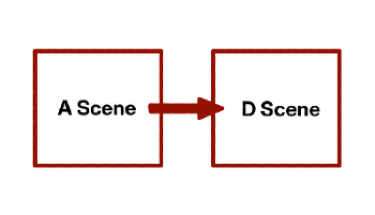
Act 1 is dominated by the inciting incident and the Act 1 break.
These two moments are what you are building and structuring around.
Where is your inciting incident? What is the narrative momentum up to that point?
This is where I struggled with my current Act 1.
The inciting incident was on page 24.
The Act 1 break was on page 38.
Does the story earn this pacing?
It does not. It wants to be shorter, much shorter, and clearly, the 24-page ordinary world is the biggest priority.
Let's break it down to that 30,000-foot view.
Our protagonist is John.
Pages 1-7. We see John’s workplace.
A couple of fun scenes. He realizes what a jerk his boss is.
Now, technically, this sets off the chain of events. But in the current draft, we don't show the event that sets off the chain. Normally, you would absolutely want to show this.
So why don't I?
- It would be challenging to get him to the emotional place he needs to be to make this decision. If we saw it in real time, it may take perhaps an extra three pages. (Funnily enough, even as I write this, I think I just figured out a way to do it without the extra three pages!)
- We can show this moment very quickly and very precisely later as a flashback and perhaps even add more value to it. This would be a single extra page instead of three.
- We have to introduce several other characters right after, and it would be hard to do that if we let this go its natural course of events. This is the weakest reason because often the answer is to just figure it out. That’s our job.
Pages 8-15. The father-in-law's birthday dinner
This is what is killing narrative momentum. This birthday dinner was going to happen whether pages 1-7 happened or not. The protagonist John is in a somber mood, but it's not really affecting the scene.
I like these scenes, but because it is not caused by the scenes before it, and it does not cause the scenes after it, it's grinding narrative momentum to a halt.
Pages 16-18. We learn John quit his job right after page 7.
He confesses to his wife what happened. We flash back to that really fun scene of him quitting his job, and now we get her immediate emotional reaction to it.
This actually works much better than I expected, but I'm still not convinced it's ideal.
Pages 19-23. John mopes around the house.
He's trying to deal with a life without a job, without much purpose, and the anxiety of both where his son is going to go to college next year and how he's going to pay for it.
Page 24. The inciting incident
Now he realizes what he wants to do. There are still 14 pages left of Act 1!
The changes.
I was able to trim quite a bit. And while there were some interesting moments that I would rather have kept, cutting was more important at this stage.
That said, I was very careful to leave the bounce and the life in the scenes. I'm not going to miss anything that I cut.
Pages 1-6. John’s workplace.
I cut a page from this.
Pages 1-13.The father-in-law's birthday dinner
I was able to cut a page from this as well. But the narrative momentum problem was still there.
So… I added a moment on page 7 where John says on the phone, “I did a really stupid thing.”
Then I re-committed to his world falling apart during his father-in-law's birthday dinner.
With the audience wondering, "Oh no, what did he do?" it gives us much more momentum through the whole sequence.
Pages 14-16. We learn John quit his job right after page 6.
This happens only two pages earlier now, but it feels much sooner because the narrative momentum has improved so much.
I am still not convinced this is the most efficient way to do this, but it's definitely a step in the right direction.
I'm going to play around with seeing him quit on page 6.
Now, him quitting is technically not the inciting incident, but as it is happening earlier, it is doing the job of narrative momentum that the inciting incident would normally do.
Which is the key characteristic of the three-part Act 1.
In sequence 3, the primary cut was a whole scene.
It's a good example of how rearranging the cause and effect can allow for just cutting out a whole scene.
The original order was this:
Pages 26-27. John’s wife asks him to invite her brother on the trip.
He doesn’t want to ask him, and she assures him he'd say no, but it will mean a lot if he asks anyway.
Pages 28-29. His brother-in-law enthusiastically says he wants to go.
Which is exactly what John was afraid of.
Pages 30-31. John asks his friend Eric to go.
Eric thinks it's all a stupid idea and has no intention of going.
Pages 32-33. John tries to talk his brother-in-law out of going.
He outlines the whole trip and exaggerates how difficult and painful it's going to be.
John's wife calls and says there's an emergency at home.
The changes.
The main trim here was realizing how much the two scenes between John and his brother-in-law were alike. But the order was in such a way that you couldn't just flat-out cut it. You had to rearrange the scenes.
Pages 24-25. John asks his friend Eric to go.
Moved this to the front of the sequence and trimmed a little, too.
Page 26. John’s wife asks him to invite her brother on the trip.
The scene is actually funnier now because he's already asked his friend Eric to go, and he said no. He really does not want his brother-in-law to go.
Pages 28-29. His brother-in-law enthusiastically says he wants to go.
I added in a little bit of exposition that was in the other scene here, but I decided some of the details about the trip can be shared later on.
John's wife calls and says there's an emergency at home.
By rearranging the order, I was able to cut a two-page scene, and the story is much better for it.
There is still work to do with Act 1.
I'm much happier with the momentum, but my gut still says 32 pages is too long.
There is a 2.5-page scene that I absolutely love on page 20. Its sole purpose is to put the idea in John's head.
It's such a fun scene, and it's hard for me to cut it entirely.
But I know I shouldn’t really need 2.5 pages to get the idea into John's head. If it was a great, signature scene, I wouldn’t hesitate.
But it's just a good scene.
And since, while writing this, I figured out how to actually have the quitting scene on page 7, I have to give that a shot as well and see what that looks like.
Not done with this Act 1 by a long shot.
Every project is different.
It's one of the things I love about screenwriting. You will certainly see problems you've seen before, but there are almost always new problems you haven't.
And at its heart, solving problems is what we do.
How do we make this happen quicker?
How do we make this plot hole make sense?
How do we make it more truthful?
How do we make it funnier, more exciting, or scarier?
How do we surprise the audience?
How do we evoke the same intensity of emotion with fewer words and fewer actions?
How do we know when to stop fiddling and move on?
This has been the most difficult Act 1 that I can remember. I've thought about just putting it on the shelf for a little while. After all, my next project is something I'm really looking forward to writing.
But I want to finish this one. I want to feel good about it, and I am pretty happy with the rest of the screenplay.
But I also know the rest of the screenplay won't work until I get this Act 1 to work.
So I keep at it. I keep trying to solve these problems.
The Story and Plot Weekly Email is published every Tuesday morning. Don't miss another one.
 Tom Vaughan
When you're ready, these are ways I can help you:
WORK WITH ME 1:1
1-on-1 Coaching | Screenplay Consultation
TAKE A COURSE
Mastering Structure | Idea To Outline