
Don’t settle for just an okay scene.
"Nothing wrong with it" is not the same as "good."
The Story and Plot Weekly Email is published every Tuesday morning. Don't miss another one.
This came up in two different lab sessions last week. Two serviceable scenes from talented writers that would have delighted me if they came from one of my college students.
But for them, they were underachieving.
They were settling for serviceable rather than what they were capable of.
This is not uncommon for talented writers. Some writers just have a knack for filling up a page.
Give them a couple of characters, a situation, and they can punch out a couple good pages, no problem.
The scene will serve its purpose; it will be truthful, even mildly amusing if it needs to be, with a nice rhythm, and there won't be anything necessarily wrong with the scene at all.
And that's the problem.
"Nothing wrong with it" is not the same as "good."
I fell into this trap all the time in my early years.
And I often find myself giving them the speech I sometimes need to hear myself: "You're a good writer. You're talented enough to write perfectly fine stuff in your sleep. That's good, but that's also bad because the challenge for you is to not be tempted to settle for that."
Not every scene has to be a great scene.
But every scene should be interesting.
And the longer the scene is, the more compelling it needs to be to justify its length.
Sure, sometimes we just have to get somebody out of the car, or even an old-fashioned establishing shot, but except for the most rare occasions, every scene tells a story.
There is only so much real estate in the screenplay, after all. Why waste any of it in mediocrity?
Unless that mediocrity is the point, of course.
See every scene as an opportunity.
Do not settle.
Now, the number one challenge for early writers is that they just don't know what makes a scene interesting to begin with.
And that’s okay. It's real, and we all must go through it. It's part of our growth as writers.
I'm not really talking about this challenge.
What I'm more concerned about in this context is settling, often for our very first conception of what the scene could be.
Say, we write the scene. It’s fine. Nothing wrong with it. It does its job.
And we want to make progress so we go to the next scene. Maybe we know in the back of our minds the scene is kind of vanilla, but once it’s done, we just want to get to the more exciting stuff.
So we do.
And it's how we get so many screenplays that just go along.
Something happens, then something else happens, and then something after that.
There's nothing wrong. It's readable.
It's just not interesting, and it's certainly not compelling.
You are not obligated to your first idea.
As with any scene dilemma, the number one question is what needs to happen in the scene, or as I like to put it, “What needs to change in the scene?”
What is true at the end that wasn't true in the beginning?
This is the intention of the scene, and it’s what remains constant.
Once we know that, we have to ask ourselves: how much time do we need to actually achieve that and still be emotionally truthful?
If we only need one-eighth of a page to do it, maybe that's what we do. Get in, get out.
But if it needs more time or we choose to take more time, we'd better make it worth the audience’s time.
"Don't go with your first idea. Go with your second or third.”
This was a great lesson I learned from improv.
You can improve just about any scene if you just keep asking, "Is there a more interesting way to tell the truth here?"
Keep the intention. That is always the focus.
But can you pervert somebody’s want? Give them an emotional reaction we didn’t expect?
Blake Edwards was a master at comic set pieces.
His genius was keeping them within an emotional narrative rather than feeling like connected sketches.
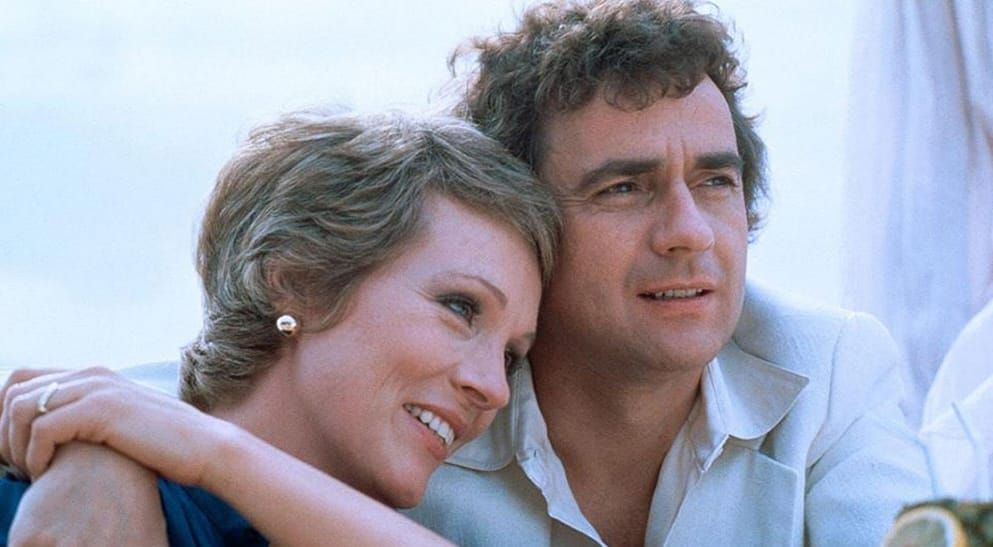
I rewatched his movie 10 with Dudley Moore this weekend (I am writing a midlife crisis movie and watching midlife crisis movies), and there was example after example of this.
In one scene, Dudley Moore's character, a famous composer, needs to talk to a priest about whose wedding it was at the church that weekend.
Very simple scene. Boring plot stuff.
But the scene itself is all about how the priest likes to compose his own music and forces Moore’s character to listen to it.
It is, of course, terrible. We then see the priest's callousness as one of the church volunteers serving him tea is an ancient woman who seems to move at 1/10th speed.
The next scene is similar, as Moore needs to get information from a dentist and ends up getting six cavities filled right then and there.
I'm not sure the pacing of Blake Edwards would satisfy today's audience, but there is no scene in a Blake Edwards film that is just plot. It is always so much more.
Having good development partners helps.
One of my favorite scenes I ever wrote was from a silly TV movie, and we were all just pulling a paycheck. I was hired to rewrite the script, and I spent a lot of time just getting it from horrible to mediocre.
The scene was all exposition with the detective and the doctor interviewing the ex-wife of the killer.
We needed info that would get the narrative to the next scene, and that's how I wrote it.
It was fine. There was nothing wrong with it. But it was just all one big non-choice on my part.
In other words, it was boring. I was settling. And the director knew it.
So he kept pushing me and pushing me for something more.
I was frustrated. I was thinking it was a dumb exposition scene, so let's get in and out. What's the big deal?
But that was Dan's point. There was exposition needed in there. So we couldn't just get in and get out. We had to stay there a while!
And screen time was too valuable to have a scene that is solely exposition.
He didn't want to be stuck with a boring scene, and it was my job to fix it.
And he was right! I was settling. I wasn't doing my job. At least not to my abilities.
I eventually found an angle that I liked, an emotional layer that still resonates with me. And it's one of my favorite scenes I've ever written.
It's in a dumb TBS TV movie, but I still absolutely love that scene.
The late-night talk show test.
It’s a simple test. Silly, yet powerful. It’s a question I encourage my students to ask when trying to determine if a scene is carrying its own weight in a screenplay.
When in doubt, ask yourself this:
If an actor from your movie is doing the press rounds and they’re on the Tonight Show or any other show where they plug the film, and they show this scene to the audience…
Does the audience want to see this movie?
They have far less context to lean on. They have no vested interests in the overall outcome of the film. They only know if this scene entertains them or not. Do they watch this “clip” and find it entertaining enough to want to see this movie?
Or do they forget about it almost immediately?
If it’s the latter, you need to keep working on the scene.
Not every scene has to be a trailer moment.
But does it at least have something unique and interesting going on?
Next time you’re struggling with a scene and wondering if it’s working or not, put it through this silly but effective test.
The Story and Plot Weekly Email is published every Tuesday morning. Don't miss another one.
 Tom Vaughan
When you're ready, these are ways I can help you:
WORK WITH ME 1:1
1-on-1 Coaching | Screenplay Consultation
TAKE A COURSE
Mastering Structure | Idea To Outline