
How to know your ending.
What questions to ask before deciding how to end your screenplay.
The Story and Plot Weekly Email is published every Tuesday morning. Don't miss another one.
We started a new Writers Lab this week. A member is working on a new story and the process we went through for her to decide the resolution is a great example of how we put story first and let it dictate our decisions.
Now, as always, when I share details of a member's story, for privacy reasons, the details only represent their story. They do not accurately describe it.
So let's say this story is about a woman whose husband goes missing in a plane crash over the Pacific Ocean.
The wife is convinced he is still alive when everyone else gives up.
So my question was, "In the end, does she find him?"
"I considered that, but it didn't seem realistic."
"We don't care about realistic," I said. "We care about emotional truth."
As storytellers, "realistic" is simply not one of our priorities.
Our primary values are story and emotion.
Like so many of my screenwriting discussions, this is an example of why story matters. Which is why Act 2 matters. And why Act 1 and Act 3 matter.
Story is character, and character is story. They are inseparable. I define story as:
The transformational journey of a human being.
This definition puts story in its proper place in both its importance to us as storytellers and in how we structure the screenplay.
Act 3 is not about the plot.
At least not in how it satisfies us. Resolving the plot is required, but it is not our primary concern.
If you just try to resolve the plot, you're going to leave the audience unsatisfied.
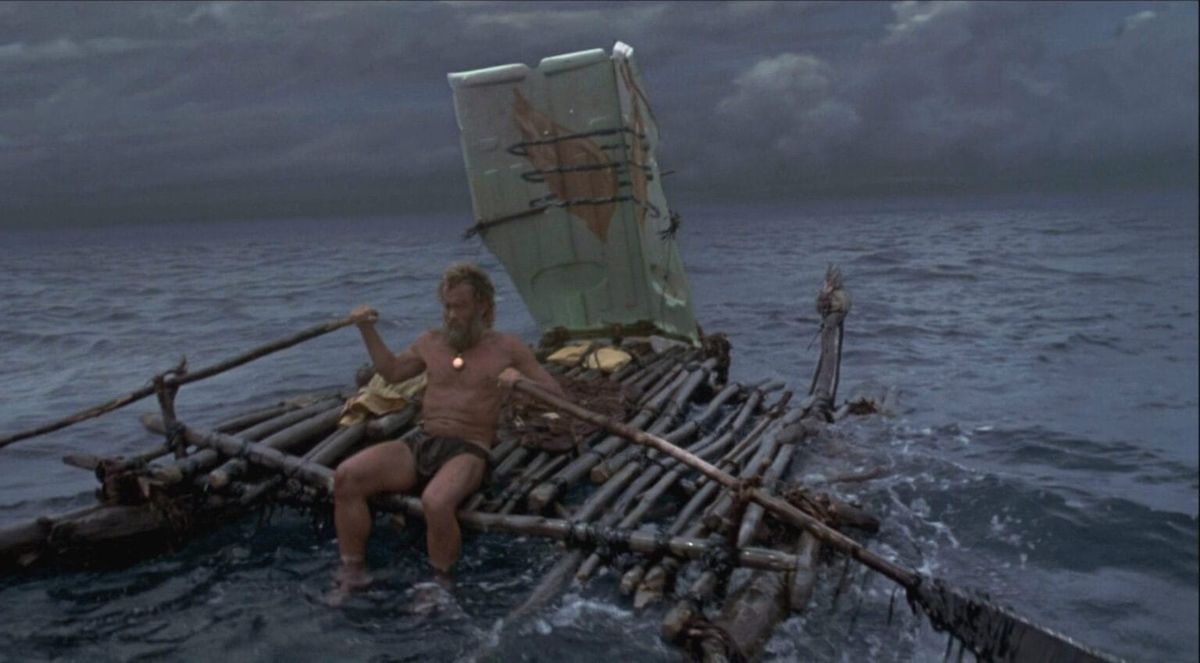
This is why "realistic" should not direct us to the resolution. Rocky going the distance isn't realistic. Tom Hanks getting off that island isn't realistic. Sandra Bullock surviving in GRAVITY isn't realistic.
Even when buying into the main conceit, the redemption story of EVERYTHING EVERYWHERE ALL AT ONCE isn't realistic.
Same with PROJECT HAIL MARY, a film I absolutely loved.
It doesn't matter, because realistic doesn't matter.
When it comes to what limits us, only emotional truth matters. We just have to believe it.
So what is the resolution about then?
For starters, think of it less as "the ending" and more as "the answer."
Act 3, and in particular, the resolution is the emotional answer to what you set up in Act 1.
In Billy Wilder's Screenwriting Tips, as told to Cameron Crowe, there is this entry:
6. If you have a problem with the third act, the real problem is in the first act.
What does he mean by this? He means if it's not working, they're not connected. Either the writer ignored the first act when they wrote the third act, or the first act does a poor job of setting up why the third act should be more moving.
In either case, go back to the first act. You will find the answers there, or you will create them.
If you're in the early stages, and you don't have an Act 1 or an Act 3, you can start this whole process by asking:
What story are you telling?
In other words, who is the protagonist at the beginning? And who are they at the end?
That's the story.
And everything we do works under that. Structure, plot, theme- it all supports that story.
So back to the main question, "In the end, does she find him?"
The answer is not found in "What is realistic?"
The answer is found in "What story are you telling?"
The writer struggled with it a bit, but I could tell she knew in her gut what it was.
Just to get it out of the way, I asked:
Does the character remain steadfast?
Is this about how this woman never gives up? She has a belief that her husband is alive even though no one else does? Does she maintain this belief, against all odds, and eventually is proven right and wins the support of everyone else to find her husband?
Is this a story of triumph?
"No."
Okay then. The person who transforms in this story is the protagonist.
So, we went through the three-question exercise.
Done well, these three questions can outline a whole character journey.
- What does this character think they want?
- What does the character really want?
- What does the character fear?
Question 1, "What does the character think they want?" represents the character in Act 1.
In this case, the wife wants to find her husband. Pretty easy here.
Question 2, "What does the character really want?" represents who they become in Act 3. This realization is what changes them.
For this story, this one gets tricky. Does she ever stop wanting to find her husband? No. At least not until they find a body. But will they ever find a body? When exactly do they give up hope?
This one wasn't so clear, so we went to:
Question 3, "What does she fear?" This is the thing that prevents the protagonist from realizing what it is they really want.
The most obvious answer is that she fears her husband is dead. And if she confronts this, then where would that take her for Question 2?
And now the answer to #2 looks like acceptance. What she really wants is acceptance that he is gone, even though there is no body and no definitive proof he is dead, only a presumption.
So this is our story:
It is a story of a woman who learns to accept something horribly painful without the closure of definitive evidence.
That's our answer to, "Does she find her husband?"
No, she does not. Because we would be telling a different story otherwise.
And yes, that's the same answer to when the reasoning was, "It's not realistic!"
But now we chose that answer because it tells our story. This is very different than feeling like it was chosen for us.
We also have our Act 1.
To make this journey even more compelling, much of Act 1 would establish that this is a woman who thinks she can control everything in her life. That acceptance of things she cannot control is particularly challenging for her.
Until life forces her to change.
Now, the real project is more exciting.
And we did have these answers initially. But we thought they were perhaps the more obvious approach, and maybe we could dig deeper into the character.
What emerged from "What does she fear?" was a character that I have genuinely never seen before and got me ridiculously excited about this project.
It goes to show you that if it's not emotionally satisfying to you, keep pushing until it is.
These questions are not homework where you are just trying to fill them out and turn them in. You want to challenge yourself. It is there that you will often find gold.
Your job is to tell the story.
This is your true north. It will guide you where to go, and it will get you back on track when you're lost.
It will help you with just about every choice you make in your screenplay.
But you have to define it first.
You're a storyteller.
You can't tell a story unless you know what story you're telling.
The Story and Plot Weekly Email is published every Tuesday morning. Don't miss another one.
 Tom Vaughan
When you're ready, these are ways I can help you:
WORK WITH ME 1:1
1-on-1 Coaching | Screenplay Consultation
TAKE A COURSE
Mastering Structure | Idea To Outline