
Non-choices drag stories to a crawl.
One of my most important tasks as a teacher is to instill the habit of making choices.
The Story and Plot Weekly Email is published every Tuesday morning. Don't miss another one.
One of my most important tasks as a teacher is to instill the habit of making choices.
Early on, so many of the things we put down on paper are just habits. Phrases we use, words, sentence construction, dialogue, everything.
Or we envision something in our head, but we’re too cautious and vague with the words we use. We’re noncommittal, afraid to make a mistake.
We’re excited because we fill up a page and that feels like enough.
It is not. If we don’t fill up a page with choices, then, to paraphrase Truman Capote, we are not writing. We are typing. And they are not the same thing.
And the reader knows the difference.
"There is no such thing as genial charm."
Generic, unspecified moments, wishy-washy characters, scenes that drift away, and scenes that take a walk around the block before they get started.
All are hallmarks of writers who are too polite, who don’t know what they want, or who don’t know what story they are telling.
Sometimes all three.
If you don’t have confidence in your writing, if you’re not excited about this story, there’s no way the reader will be.
Choices are both large and small.
They include the largest choice of all of what story you’re telling all the way down to the single verb or the adjective you add or refuse to add to describe a noun.
Sanford Meisner had this advice to his actors:
“There is no such thing as genial charm.”
It’s inauthentic. It’s untruthful and largely serves no purpose.
Politeness is boring. It’s designed to diminish conflict and prevent drama. Often good in life, less so in literal drama.
Characters that don’t feel strongly about something are tougher to pull drama from. If they don’t have a definitive point of view, there’s nothing for us to define them by, it doesn’t influence their choices, and there’s no real impact if it changes.
Non-choices evoke little to no emotional reaction.
They’re just information. They sit there doing nothing. Non-reactive. Not helping, and because they’re taking up space an actual choice could, they are definitely hurting.
Specifics are not enough.
You’ve heard the advice to be specific. This is true. But specifics are just details. If they don’t serve an actual purpose, they’re only a slight improvement.
They help to imagine a specific image, which is great, but the image doesn’t evoke a response, which is less great, and a missed opportunity.
So, while we say, “Be specific,” the goal is to have an effect on the audience.
And being specific is a tactic to that goal.
Here is an example from a talented writer I like. It’s a dinner scene with a single father and his eight-year-old son:
This is not bad. I would give it a much better-than-average grade. Choices are made. Slightly overcooked fish sticks, mashed potatoes, and peas.
Much better than what the 100% non-choice would look like:
There is absolutely nothing there. Generic. Polite. So, the former is much better than the latter. The details tell us what little care went into the meal.
It was quick and easy, but responsibilities were met to feed the child. If the choice was canned food, or fast food, that would tell us something different about the father.
But… just one thing.
What’s with the “slightly” overcooked fish sticks?
Why slightly?
It sounds like a more specific choice, but it is actually a non-choice. While the adverb modifies the adjective “overcooked,” it actually weakens it, rather than making it stronger.
So why do it?
This is a good example of how random specifics don’t help you as much.
Only specifics that support an intention do.
“Slightly overcooked” turns a choice of overcooked fish sticks to a non-choice of “slightly overcooked fish sticks.”
You may say, what’s the difference? Who cares? What does it matter?
Well, that’s the point. Who cares? “Slightly overcooked” expands the possibilities of what it might mean to us, and we want specifics to narrow those possibilities.
“Slightly” might tell us one thing, it might tell us another. Or another. Or another.
Is that choice about their taste? Is it about how they don’t care? Is it about how the father doesn’t know the difference? So many possibilities.
So it ends up meaning nothing.
But “overcooked fish sticks” immediately makes us think the busy father screwed up. That is a definitive choice about the cook.
Sure, it could mean multiple things. But the strong, definitive choice gives us a strong, definitive reaction.
A very clear choice tells us that a very clear mistake was made.
So we make a definitive choice and we stick with it. See the open lane and hit it. Don’t hedge, don’t weaken.
So make the choice.
You cannot make smaller choices without making bigger choices.
The biggest choice of all is what story you are telling.
This is why I define what story is so clearly. So I can use that definition to define the story I am telling just as clearly.
Simplify, simplify, simplify.
We spend a lot of time in our Story and Plot Labs narrowing down our choices.
It is natural to want to write down A LOT to explain what story we’re telling, what a scene is about, and who a character is.
We can absolutely fill up pages with this stuff if we let ourselves.
Far more often than not, however, all those details and “nuance” are used to disguise the fact that we didn’t make a choice.
It is far more productive and effective to narrow it down to one thing.
- This is a story of a man who dresses up as a woman and becomes a better man.
- This is the story of a perfect doll who realizes the joy of being imperfect, impermanent, and alive.
- This is the story of how a man’s determination, against all odds, converts the doubters to rescue Americans trapped in Iran.
This works for scene work as well.
What is the scene about? What needs to change by the end of the scene?
- This is the scene Eddie says no f-ing way to the trip.
- This scene terrifies Barbie enough to seek help.
- This is the scene John gets so fed up he quits his job.
- This is the scene Frank is embarrassed enough to then confront Allen.
What needs to change in the scene that affects a following scene?
Once you know what that is, once you make that choice, you now have a true north for what goes in that scene and what stays out.
Don’t try to make a scene about two things at once.
Your scene is about one thing. Yes, you can sprinkle details of other things in there. You can share other information in that scene, but the emotional shift should be one thing.
In other words, you can DO MULTIPLE THINGS in a scene, but avoid the scene being ABOUT multiple things.
For example, I had 20 minutes last night to cool my mind down. Not enough time for a full movie or even a TV show.
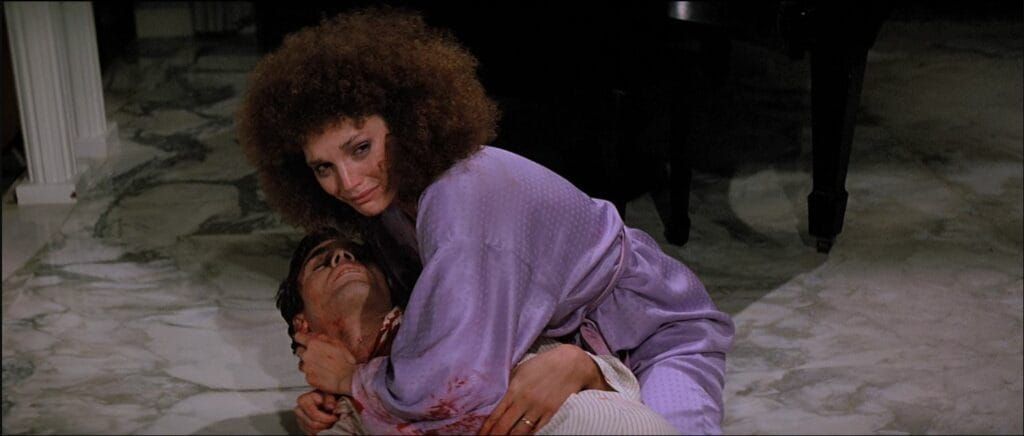
So I chose to watch a short bit of SCARFACE.
I have seen it 100 times, and I have been watching it in bits and pieces lately when I have short openings like last night.
There is a scene when Tony marries Elvira. It is the victorious montage of Tony at the height of his success. He gets the money, he gets the girl, he gets everything he wants.
But the marriage itself is just information.
There is no close-up here of Tony, no close-up of Elvira. We see the ceremony and we accept it as a natural step to everything else that is happening.
Because the story of the scene is not about them.
The scene is about Tony’s sister Gina and his best friend Manny.
They’re the ones who get the close-up, they’re the ones that share loving stares, and they’re the ones that evoke the emotional reaction of, “Oh, no, that’s trouble,” from us.
The scene is doing two things at once, but it’s ABOUT Gina and Manny.
Know the story, know the scene, know the moment.
All these decisions start from the top. This is why I spend so much time with writers to get them to make those big decisions first.
Once you make those big decisions, each smaller decision becomes easier and easier.
Because smaller choices serve the larger choices, you know why the smaller choices are there in the first place. You know what you want them to do.
Two questions for every choice.
- What story are you telling?
- What emotion are you trying to evoke?
These two questions will help guide you for just about every choice in your project.
If you know the story you’re telling, then you know the character and where they are on their journey.
The type of dinner that dad from earlier prepares for his child is likely very different in the beginning of the story than it is at the end.
And how do you want us to feel about it? Is it funny? Is it tragic? Does it make us laugh or make us angry?
Make that choice and deliver it decisively.
No moment in your screenplay is truly independent of the story. And emotion, after all, is why we are here.
We all have habits in our writing.
And we usually start with the habits of noncommittal non-choices.
But if we fight through that, if we go through the work of meticulously reviewing our words, we can change those habits.
We can get into the habit of making actual choices.
Do that, and you will get increasingly better at the choices you make.
This is how you earn confidence in your screenwriting. If you know the answers to the two primary questions above, you will be able to choose:
- What is the role of this scene in the story you’re telling?
- What happens in the scene that fulfills that role?
- What is the emotion of the scene?
- What is the emotion of the moment?
Soon, you’ll be making these choices automatically. You won’t even think about it. You’ll just do it. They will become your new habit.
And you’ll start making more interesting choices, too.
To others, it will look like magic. They’ll think it’s God-given talent.
But all it really is is that you dropped an unhelpful habit and got into the storytelling habit of making actual choices.
The Story and Plot Weekly Email is published every Tuesday morning. Don't miss another one.
 Tom Vaughan
When you're ready, these are ways I can help you:
WORK WITH ME 1:1
1-on-1 Coaching | Screenplay Consultation
TAKE A COURSE
Mastering Structure | Idea To Outline