How to manage a large cast of characters.
A lot of characters in your screenplay? Take it upon yourself to make this easier for the reader,
The Story and Plot Weekly Email is published every Tuesday morning. Don't miss another one.
The last two screenplays I read both felt like they had a massive cast of characters. One actually did. There were dozens of characters running around this big historic event.
The other, it turned out, was about average. Three main characters and a half a dozen or so supporting characters.
It just felt like a massive cast because I struggled to keep track of who was who. So many characters, so much action. It was frustrating and confusing.
It didn’t kill it for me. I stuck with it, and in the later parts of the story, I got more comfortable. But there is no reason any of us should take that kind of chance.
Clarity of Intent.
One of the repeated tenets of all of my teaching is clarity of intent. Even if we deliberately want to be unclear, we need to be clear that is our intent.
The screenplay is a textual account of a proposed movie on screen. As writers, we try to evoke all the visual and auditory advantages of a movie, but we never truly have them.
We cannot rest on the idea that “it will be clear on screen.”
It has to be clear now. It has to work on the page. Otherwise, it’s not making it to the screen.
In a movie, we can see a very specific face, and it makes it obviously much easier to remember who they are. In a movie, we are far more likely to forget their name!
In a screenplay, however, the connection to a face that exists only in our mind, if at all, is much more difficult.
Throw enough names around in a short period of time, and we could easily forget which one of those characters is even the lead.
It is a recipe for one thing we must avoid: a confused reader, whose attention is now drifting away.
Do not take the reader’s attention for granted.
This isn’t meant as a dig at how easily they can be distracted, though that is true of anyone. It’s about understanding how challenging it can be to read a screenplay.
The more characters you have in your story, the more aware you must be of the challenges this creates. Keep this in mind throughout.
Avoid introducing multiple characters in one paragraph.
You know how a lot of exposition at once can be hard to absorb? That’s true for any information you give the reader.
No one’s going to remember Lucy and Lina after that. Not their names, and not what makes them different. Better to slow this down. If a character is worth remembering, they’re likely owed their own character introduction in their own paragraph.
Avoid character names that look similar.
This is one of those things that makes little difference on screen but makes the reader’s job more challenging.
People will often skim past the character name speaking.
They see it, but they don’t necessarily read it. They recognize the shape, maybe the first letter, then read the dialogue.
Lucy and Lina will meld together over time and will likely confuse. Ideally, a reader should know who’s speaking without seeing the character name, but this unnecessarily tests that.
These names will also be confusing in action-heavy scenes as well.
Unless there’s a good reason for such a thing, and there sometimes is, I would avoid this.
I will sometimes go as far as deliberately matching up shorter or longer names for just this purpose.
Take responsibility for the challenge.
Simply understanding that you have a lot of characters in your story and someone could struggle is a giant step in the right direction.
Don’t be one of those people complaining that the reader didn’t read it carefully enough. It’s your job to be clear and compelling enough that they do.
Remember, your effort to make the screenplay an easier read scales to everyone who opens your script. It makes everyone’s job easier.
If you ask a reader to put forth more effort, they’re the only one who gets the benefit.
Here are some active strategies:
Lower the number to the minimum.
Well, sure. Obviously, right? But sometimes you can’t. Sometimes you have a baseball team, and that’s at least nine players on the field.
Maybe it’s a fraternity, and a six-member fraternity is just kind of sad. But given all your restraints, lower the number to the absolute bare minimum.
To do this, you must know each character’s purpose.
Why are they there? How do they affect the protagonist? Is it worth the possible confusion and dilution of other characters?
Once you identify those roles, you’re likely only talking about four or five of those characters as truly supporting characters. Let the rest be essentially background.
This is why true-life stories often combine characters.
Give each character a very quick, discernible characteristic to help us define them instantly.
One is the rich, snobby guy. Another is the dude from Texas, or the complainer. Another is the big, weightlifting kid, or the brainy woman who is uncomfortable around guys. The nerd, etc.
It can be whatever you choose. Make it simple and make it interesting.
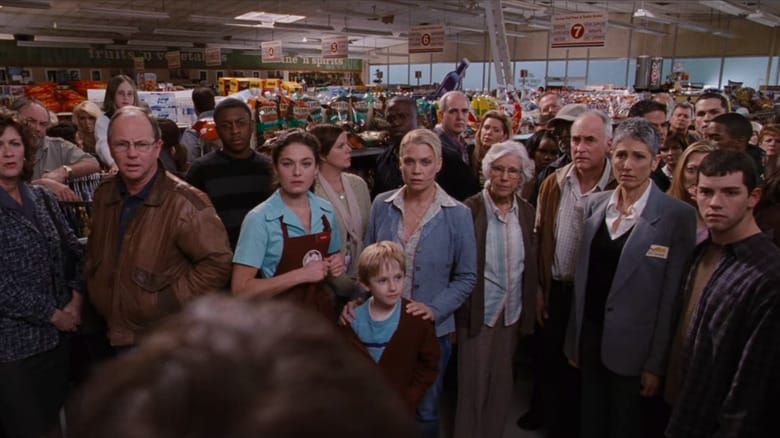
I just watched THE MIST again last night, and that story has a crowded grocery store of panicked buyers. A full grocery store!
Yet I can identify most of those characters by something easily identifiable.
The biker. The cowboy. The blue-collar worker. The soldier. The store manager. The butcher. The young cashier. The older lady. The religious nut.
That movie has A LOT of characters, and yet I can say two or three words and you would know exactly who I was talking about.
Don’t introduce a three-dimensional character.
Introduce a two-dimensional character and reveal more layers later on. This isn’t just easier for the audience, it’s more fun.
Give them a name that essentially tells us who they are.
Rich, snobby guy? His name is Farnsworth. The fraternity slob? The brothers have nicknamed him Puke.
Readers and audiences love nicknames for some reason.
The dumb, gorgeous blonde? Chrissy. The smart, gorgeous blonde? Emily. The foreign, gorgeous blonde? Genevieve.
You could, of course, go ironic. The tall dude is called Bilbo. You get the idea.
Don’t hesitate to flat-out remind the reader.
You’re telling them a story, after all. Be clear with them. There is nothing wrong with just plain saying, “She’s the officer from the first scene,” or “That’s the jerk that punched him in the face.”
I’ve written before about “Show THEN tell,” and this is a great time to do that.
Another film I watched this last week revealed the killer in the final scenes. They pull off the mask and… it’s that guy.
“You!” the main character said. And it took me a moment to place the face. And I was looking at his face! He was in one scene 45 minutes earlier.
In the screenplay, this is definitely a moment where you would tell the reader who he is to remind them. Simulate that moment of recognition in the text.
With this, the reader is in the flow. They’re being fed the exact thought and moment of realization they would have if they were watching.
This is a far better experience than “Wait. Who’s Terry?” and then flipping back pages to try to find when Terry is mentioned and then trying to get back into the rhythm of the story.
Have a strategy.
This is why reading screenplays is so important. It helps you understand what challenges come up from the reader’s point of view.
I often struggle to keep track of too many characters in a story. I don’t want a reader to feel that way about my script.
So I find ways to stay ahead of it. I ask myself what would make something easier for me, and I try to do that in my screenplay.
This has led to considerable improvements in the readability of all my screenplays.
A huge part of our job is anticipating a problem before it happens. If we do, we can get ahead of it and ensure it never does.
The Story and Plot Weekly Email is published every Tuesday morning. Don't miss another one.
 Tom Vaughan
When you're ready, these are ways I can help you:
WORK WITH ME 1:1
1-on-1 Coaching | Screenplay Consultation
TAKE A COURSE
Mastering Structure | Idea To Outline