How do I write this genre?
Genre does not limit you. It doesn’t force you to do anything. It simply makes your choices easier.
The Story and Plot Weekly Email is published every Tuesday morning. Don't miss another one.
A new subscriber emailed me and asked, “What are the key things to look out for when writing comedy?”
I have been writing and teaching a long time, and it’s not too often that I am stumped by a question. And yet this simple inquiry froze me up.
What ARE the key things to look out for?
To be funny, sure. But he obviously knows that, so that wasn’t what he was looking for. He was looking for something actionable and specific.
Then I realized: I’ve been asked this question many times before in other ways.
It’s usually in some form of, “How do I write this genre?” or “Can you help me, even though you don’t seem to specialize in this genre?”
The answer to every one of these questions is the same. This answer is annoying, because it sounds coy. But it genuinely helps to reframe the challenge.
So the answer to these questions is this:
It’s the wrong question.
This is because you are not writing a genre. You are telling a story.
The story comes first. Period.
The genre is part of what I call The Fun. And while the genre is important, it comes after the story.
In fact, it is downstream from most of the really important decisions.
Knowing your genre is huge.
It’s a giant decision.
But once you’ve made it, you’ve made it.
You can make FATAL ATTRACTION a thriller or a comedy. You can make MEET THE PARENTS a comedy or a thriller.
You can make GROUNDHOG DAY a comedy, horror, or a sci-fi action movie.
Your responsibility to that genre will be met with the emotion you evoke and the type of scenes you generate.
Any true requirements of the genre will be met there.
A comedy will be funny. A horror film will horrify. A romantic comedy will have romance and comedy. Drama will generate emotional tension.
Even then, the genre is just one ingredient of those scenes! Tone and the concept are more important.
Why? Because they are more specific.
But you are still just telling a story.
And that story is your true obligation. The decision of what story you are telling is the supreme factor in all other decisions.
It should work in conjunction with other choices, like genre, and, when in conflict, override them.
Story structure is genre agnostic.
It’s in the name. It’s story structure, not genre structure.
And story is about transformation.
What is the journey of the characters? Who changes and how? Is this transformation tragic or for the better? Does the protagonist change, or do they change those around them?
Genre is the bigger attraction than story, but you structure the same way, depending on what story you are telling.
Like structure, genre does not limit you.
It doesn’t force you to do anything. It simply helps you make choices to achieve your intention.
What we think is genre-specific usually isn’t.
A few years ago, I was hired to write a haunted house movie.
I watched about 10 haunted-house movies in a week! I will do this often, looking for mood, tone, and even tropes or expectations that might be fun to undermine.
Now, the most important problem to solve for any haunted house movie is “Why don’t they leave the house?”
Why don’t they just pack their bags and leave?
This is similar to “Why don’t they just call the police?” in so many thrillers.
These are legitimate questions, but they are not as genre-specific as you think.
They are simply variations of the most common question for every genre:
“Why don’t they do the most obvious thing to solve their problem?”
In other words, you will have the same narrative challenge for every story. They will take on the dressings from that genre, but they remain the same challenge underneath.
The three primary decisions.
The first two are mostly genre agnostic:
- What story are you telling?
- What is the dramatic question?
One-third of the third question IS the genre:
- What is “The Fun”?
The Fun = Concept + Genre + Tone.
Define all the things above (story, dramatic question and fun) and you have the criteria to make just about every decision in your screenplay.
You will be able to structure your story, allowing you to create great characters and place them in compelling scenes.
But in execution, the genre is probably the broadest of these decisions. It will put you in the ballpark for what makes for great scenes, and then the other decisions take over from there to get more specific.
One genre, three stories, three different tones.
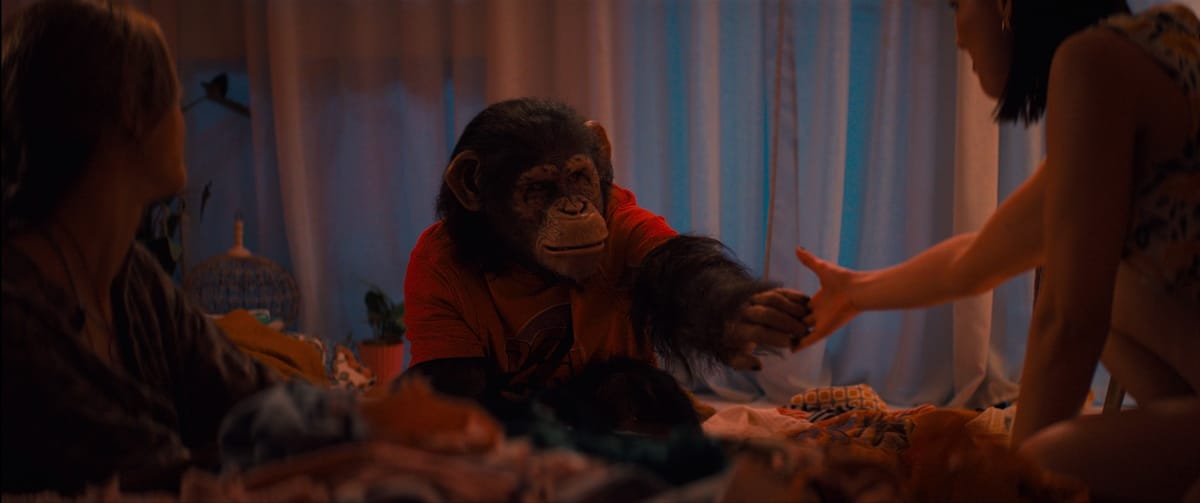
I watched PRIMATE (2026) over the weekend. It is essentially the same idea as two films I like very much, THE SHALLOWS and CRAWL.
In all of these movies, a protagonist is trapped in a closed space while a ferocious animal waits to kill them. They are monster movies.
In THE SHALLOWS, it’s a shark. In CRAWL, it’s alligators. In PRIMATE, it’s a family chimpanzee who has contracted rabies. (Stephen King’s CUJO has similarities, but it’s been too long since I have seen that.)
While the general concept and genre are all essentially the same, it is the particulars of the story and the tone that are different.
It is in THOSE choices that the real decisions are made.
What story are you telling?
Other than the obvious of location and the type of monster, there are two primary choices that make these films different.
In THE SHALLOWS, the protagonist fights for herself after her mother's death. Both physically and mentally. She is ALONE.
In CRAWL, the protagonist fights for her father after her mother's death. It is her and her FATHER.
In PRIMATE, the protagonist fights for her sister after her mother's death. It is her, her SISTER, and their three other friends.
Okay, so maybe these stories aren’t so different after all!
In fairness, the deceased mother is less of a thing in PRIMATE. More of a plot point than a story point.
But in all three cases, once the concept and genre were decided, no more needed to be done there. They now take care of themselves.
It’s the particulars after that that will have a much greater impact.
First, what is the dramatic question: “Will she live?” vs. “Will she save her loved one?”
These change the tactics, the stakes, and some structural decisions.
An even bigger difference is the tone.
It is the difference in tone in these movies that shifts the sub-genre.
THE SHALLOWS and CRAWL are survival horror. They’re grounded, gruesome, and frightening. The power of nature is on full display.
But PRIMATE makes a different decision. The tone is different. It’s not nature doing what it does. It’s gory and seems to take pleasure in the types of “kills” it delivers on its characters.
It’s a slasher film and best enjoyed by those who enjoy slasher films.
A slasher movie, by definition, needs a body count. So, PRIMATE naturally needs more characters in that pool with the protagonist.
The type of sub-genre is a bigger choice than the genre itself.
Writer and teacher James Nash posted a very funny (and useful) scale in reply to an X post of mine over the weekend.
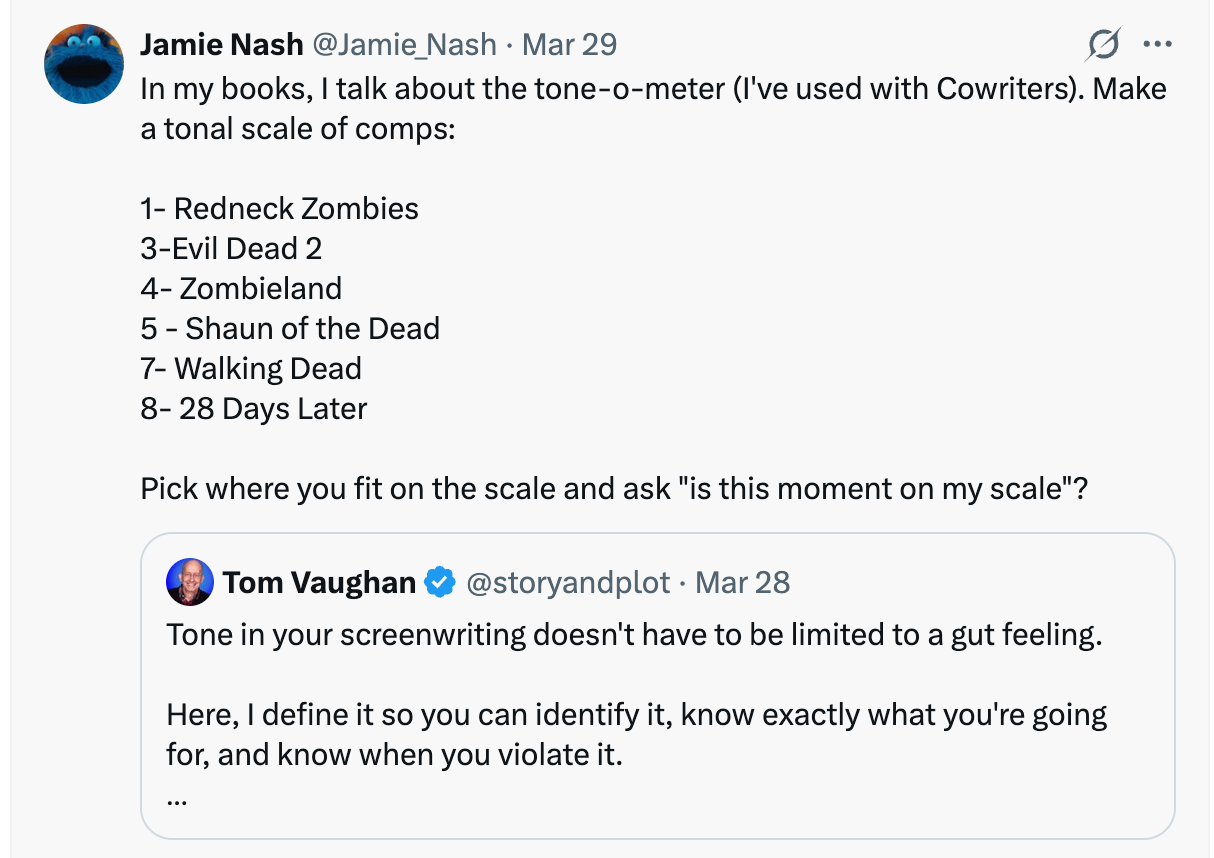
The genre is the BIG choice. The tone is the SPECIFIC choice.
Do not let genre intimidate you.
I do think you have to enjoy a genre to really enjoy writing it. That said, if you worry that you don’t know the conventions or expectations of a genre, you can let that go.
You really only need to know a genre well enough to avoid its clichés.
Other than that, you are simply telling a story, and you are generating great scenes that trade in on the fun of that story.
That’s whether it’s laughs, adventure, romance, or terror.
Sometimes your concept wants to be a certain genre.
I have had students generate fun concepts that clearly wanted to be comedies, but because that frightened them, they tried to turn them into dramas!
It didn’t work. The story was telling them what it wanted to be, and they let their own self-doubts restrict them.
It’s true, not everyone can write a full-blown comedy.
Comedy is hard. But so are horror, science fiction, and action. It’s just not everyone’s sensibility. They will stop themselves before really digging in.
But not everyone can write either! And that hasn’t stopped any of us.
We know failure is a possibility, and we keep going.
It’s one thing to try and fail. It’s another to fail before you even try.
A light comedy that focuses on character and the emotions of the story is something most of us can do.
Why? Because it’s a question of tone. You’re trading in on good vibes and light emotions rather than belly laughs.
Tone is more important in execution.
If you are looking at a genre you haven’t explored yet and you’re worried whether you can pull it off, try the easiest tone before the more extreme one.
Now that I think about it, that’s exactly what I did with comedies!
In the 90s, I wrote two romantic comedies. They were well-received but didn’t sell. One had Diane Lane attached. I loved that script!
I didn’t write a full comedy until I did so with Kristy Dobkin in 2003 or so. I didn’t SELL a comedy until 2018.
I mostly wrote action, horror, and thrillers in between.
But writing romantic comedies (which I love), which lessened the pressure to be hilarious in every scene, was where I built my confidence.
In every case, I structured each narrative around the story. Only the concept and the tone were really different.
Obviously, if you’re already in your preferred lane, hit the gas. Floor it.
But if you’re uncomfortable…
What tone can you dip your toes in?
If you have an idea that WANTS to be a comedy, but that scares you…
Write the LIGHTEST of light comedies. Focus on the characters and their emotions. You don’t have to maximize the comedy, just don’t do anything that VIOLATES a comedy.
Once you get more confident, you can play with blurring lines and challenging expectations.
Perhaps your idea wants to be a horror film?
Maybe make it a thriller before tackling a slasher or a James Wan-type ghost story.
You are never under the obligation to write the best screenplay ever written.
Your obligation is to tell THAT story to the best of YOUR abilities.
You do that with the Big Three.
These three choices dictate all the smaller choices:
- The dramatic question.
- The story.
- The Fun (concept + genre + tone).
Genre helps you narrow down choices, but the others allow you to make the specific choice.
The Story and Plot Weekly Email is published every Tuesday morning. Don't miss another one.
 Tom Vaughan
When you're ready, these are ways I can help you:
WORK WITH ME 1:1
1-on-1 Coaching | Screenplay Consultation
TAKE A COURSE
Mastering Structure | Idea To Outline